I took two walks one day along the fence line, once for enjoyment and once to repair the fence. I was amazed both times at the spectacular displays of wildflowers I saw. This wild collection for instance was Queen Anne's Lace, Red Clover, Black-Eyed Susan and Goldenrod:
Just a few steps farther and I saw Common Boneset (more on this later in this post), Purple Loosestrife and Goldenrod:
But what on earth were these tiny, daisy-like flowers? I took a number of photos to look them up back in the house:
I looked them up and decided that they were probably Tradescant's Aster, a new plant for me. I later found a picture of Prairie Fleabane and thought that it might be that also. Whatever it was, it was interesting:
This single Common Mullein stood five feet high and right next to the fence wire (I'd turned off the electricity):
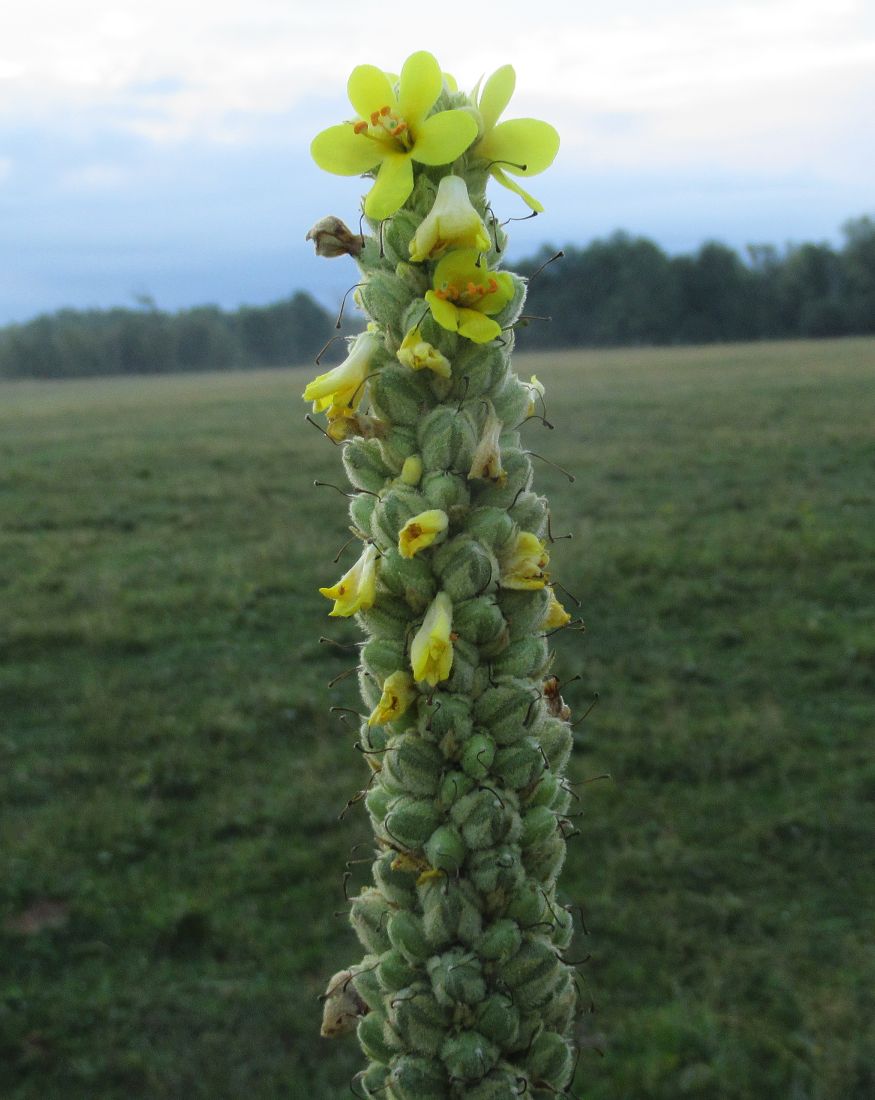
A close-up of Common Mullein's flowers:
This was a familiar old favorite which, for most of my life, I called Coffee Grounds. The real name is Curly (or Curled) Dock, but when we were kids, we'd strip the seeds from the stalk and pretend they were coffee grounds, which they did resemble:
I don't remember Common Boneset ever growing in my fields before, but there is a lot of it this year:
Boneset got its name because its leaves are joined at the stalk, prompting pioneers to think it could heal broken bones. Native Americans knew better and used it for fevers and as an antibiotic/anti-viral. Some people still use it today:
My photo of these minuscule flowers wasn't very good. They were exceedingly small and looked a lot like Lobelia flowers. I looked them up when I got back to the house and decided that they were indeed a form of Lobelia, named Indian Tobacco. They were mostly lavender color although they look white in this photo:
Queen Anne's Lace and St. Johnswort. The day honoring St. John's Day beheading is coming up and I must remember to test the sap to see if it is red:
Showing posts with label Red Clover. Show all posts
Friday, August 24, 2018
Monday, July 9, 2018
Lawn And Garden Musings
I've been busy around the yard lately. One small job, which I've considered doing for a long time but never accomplished, began with dumping some compost over the fence into the dogs' yard:
I used it to cover up two rocks and to fill in a low spot. How much good it will do and if the dogs will leave it in place remains to be seen:
One of the most ubiquitous wildflowers in the yard began to flower. It is Bladder Campion, a member of the Pink family. And of course that is Red Clover below:
You've seen lots of photos of the healthy Ninebark, but I've been distressed about the one which got sick last year and is now stunted and haven't photographed it. Today I noticed that it is growing and doing well, albeit a year behind its nearby relative:
The little rock garden is so crammed with flowering perennials now that I can't even pull weeds - except at the outer margin. I took this photo to illustrate the Asiatic Lilies preparing to bloom and the three or four stems of Blue Sea Holly which are developing rapidly. Only the one on the right is beginning to turn blue so far:
Photos of the Blue Sea Holly flowers show it to have feathery, blue "petals." If they're going to have such blue petals, they'll need to start growing some soon:
I was surprised to see that the Magic Carpet Spirea had nearly doubled in size and was blooming profusely. It is a dwarf variety, but looks as if it will be able to hold its own, even as the other plants outgrow it:
And another shot of the old fashioned rose. It was putting on such a display that I couldn't resist. It pleases me to think that it survived a decade or more of being mowed down, and that I then saved it by simply mowing around it:
Another common wildflower has begun to bloom. It is a member of the Mint family and I have trouble remembering its name every year. But this year I recalled it with a glance at my field manual. It is called Motherwort because tea from its leaves was used to ease tension and other ailments of new and expectant mothers:
And in the lawn, the ubiquitous Heal-All has begun blooming (and so has White Clover). Also called Self-Heal, the plant has been used as a poultice for all kinds of wounds, rashes and skin ailments. I have read that new studies seem to indicate it can also inhibit the growth of viruses, including HIV:
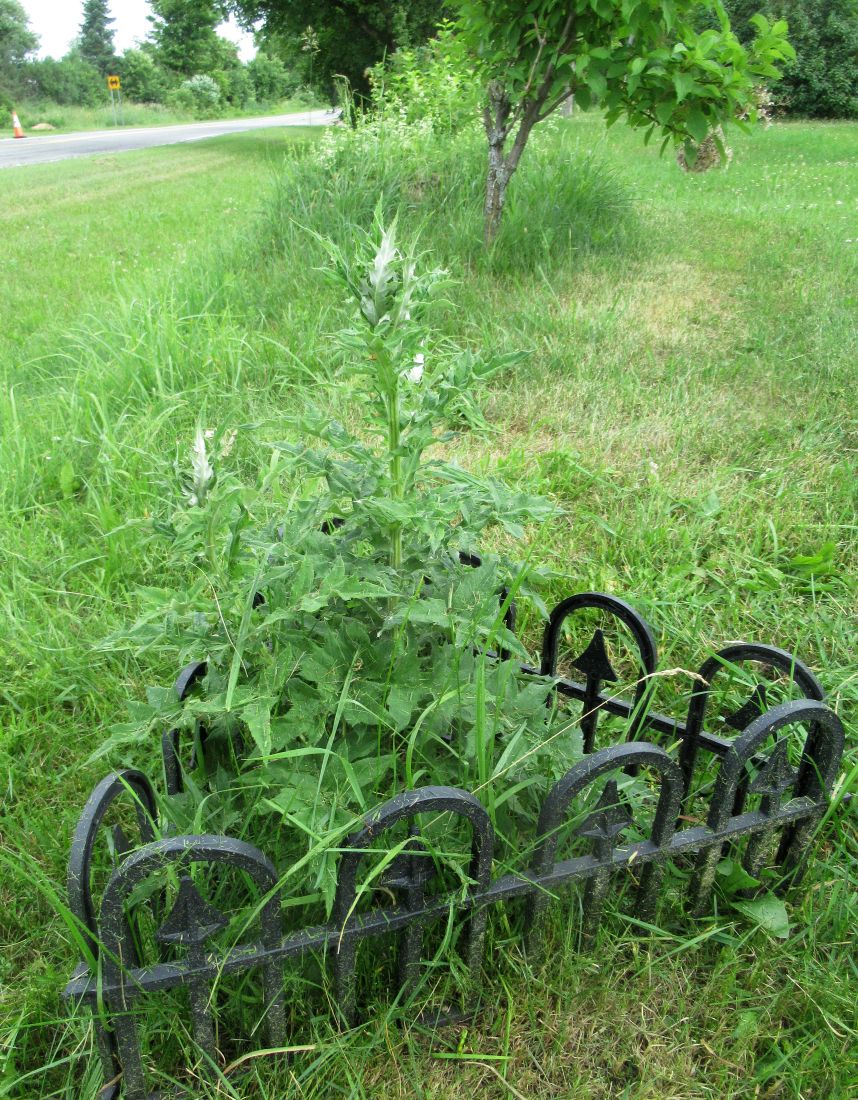
Do you remember the trouble I had getting a Globe Thistle to grow? It took a few years and lots of effort, but I finally have one healthy plant - and this year it is sending up about three flower shoots:
At the top of each shoot I can see one baby "globe" developing, though I suspect there will be more of them. Maybe it will spread and I will have more Globe Thistle plants in the future. I've read that they are not invasive and several attempts to grow them from seed have failed, so that may not happen. Nonetheless, I'm happy to have this one:
I used it to cover up two rocks and to fill in a low spot. How much good it will do and if the dogs will leave it in place remains to be seen:
One of the most ubiquitous wildflowers in the yard began to flower. It is Bladder Campion, a member of the Pink family. And of course that is Red Clover below:
You've seen lots of photos of the healthy Ninebark, but I've been distressed about the one which got sick last year and is now stunted and haven't photographed it. Today I noticed that it is growing and doing well, albeit a year behind its nearby relative:
The little rock garden is so crammed with flowering perennials now that I can't even pull weeds - except at the outer margin. I took this photo to illustrate the Asiatic Lilies preparing to bloom and the three or four stems of Blue Sea Holly which are developing rapidly. Only the one on the right is beginning to turn blue so far:
Photos of the Blue Sea Holly flowers show it to have feathery, blue "petals." If they're going to have such blue petals, they'll need to start growing some soon:
I was surprised to see that the Magic Carpet Spirea had nearly doubled in size and was blooming profusely. It is a dwarf variety, but looks as if it will be able to hold its own, even as the other plants outgrow it:
And another shot of the old fashioned rose. It was putting on such a display that I couldn't resist. It pleases me to think that it survived a decade or more of being mowed down, and that I then saved it by simply mowing around it:
Another common wildflower has begun to bloom. It is a member of the Mint family and I have trouble remembering its name every year. But this year I recalled it with a glance at my field manual. It is called Motherwort because tea from its leaves was used to ease tension and other ailments of new and expectant mothers:
And in the lawn, the ubiquitous Heal-All has begun blooming (and so has White Clover). Also called Self-Heal, the plant has been used as a poultice for all kinds of wounds, rashes and skin ailments. I have read that new studies seem to indicate it can also inhibit the growth of viruses, including HIV:
Do you remember the trouble I had getting a Globe Thistle to grow? It took a few years and lots of effort, but I finally have one healthy plant - and this year it is sending up about three flower shoots:
At the top of each shoot I can see one baby "globe" developing, though I suspect there will be more of them. Maybe it will spread and I will have more Globe Thistle plants in the future. I've read that they are not invasive and several attempts to grow them from seed have failed, so that may not happen. Nonetheless, I'm happy to have this one:
Wednesday, June 20, 2018
Plants And Birds
Wild Blackberries burst into bloom everywhere I was unable to mow - or were they Black Raspberries? I went to the internet for some ID pointers, but found them scarce and difficult to use. Then I found a website which was wonderfully helpful and easy to use. It confirmed that I have Blackberries, not Black Raspberries. I highly recommend this site:
My north field was getting very tall and my neighbor decided it was time for its first cutting:
It was so thick and heavy that it was slow and difficult to mow:
This was some seriously tall, thick, lush, heavy hay! As of this writing, the first part of the field has been cut and will be turned over to dry (tedded) today. About 3/4 of the field remains to be cut:
My Rugosa Roses suffered badly from a fungus last year, along with the apple trees and one of the Ninebark bushes. But this year they continued blooming faithfully:
So far, I see no fungus except on the one Ninebark which was affected last year:
The Variegated Weigela was a dead looking stick a few weeks ago. Now it is blooming!
The white Peonies (and one new red one) are building up to a flowering frenzy:
And the Snowball bushes are doing extraordinarily well:
I had no Cliff Swallow nests under the milk room eaves this year - until now. I found two adjacent mud nests, filled with birds. As soon as I snapped this photo, 6 to 8 birds burst from those holes and flew around, scolding me. I hope they keep the biting flies in check. The cows and horses (and I) will be grateful:
In the lawn and pasture are many of these tiny white flowers, each petal split into two. They are Lesser Stitchwort, a kind of Chickweed. The grass head is Redtop:
And of course the big, beautiful Red Clover. 'Tis the season:
My north field was getting very tall and my neighbor decided it was time for its first cutting:
It was so thick and heavy that it was slow and difficult to mow:
This was some seriously tall, thick, lush, heavy hay! As of this writing, the first part of the field has been cut and will be turned over to dry (tedded) today. About 3/4 of the field remains to be cut:
My Rugosa Roses suffered badly from a fungus last year, along with the apple trees and one of the Ninebark bushes. But this year they continued blooming faithfully:
So far, I see no fungus except on the one Ninebark which was affected last year:
The Variegated Weigela was a dead looking stick a few weeks ago. Now it is blooming!
The white Peonies (and one new red one) are building up to a flowering frenzy:
And the Snowball bushes are doing extraordinarily well:
I had no Cliff Swallow nests under the milk room eaves this year - until now. I found two adjacent mud nests, filled with birds. As soon as I snapped this photo, 6 to 8 birds burst from those holes and flew around, scolding me. I hope they keep the biting flies in check. The cows and horses (and I) will be grateful:
In the lawn and pasture are many of these tiny white flowers, each petal split into two. They are Lesser Stitchwort, a kind of Chickweed. The grass head is Redtop:
And of course the big, beautiful Red Clover. 'Tis the season:
Thursday, November 2, 2017
Autumn On The Rutland Trail - Part 3
The dogs and I were hiking a section of the Rutland Trail (see also previous two posts) and had gotten farther than ever before because someone had built a bridge over a formerly inundated section. Other spots were still wet, however, and I tried to keep the dogs from drinking out of the shallow pools:
Red Clover was in bloom along the trail. Certainly a common plant, it still surprised me to see flowers in bloom so late in the season:
Virgin's Bower Clematis seed heads made for a striking, autumn display:
When we returned to an access point to the main body of water, I encouraged the dogs to drink there instead of from puddles along the trail:
We were a happy group, making our way back along the trail:
The wind began to pick up as we arrived back at the bridge, and it was gusting with enough force that I wondered if a big storm was brewing. It turned out to be only wind, however, and merely added to the spirit of autumn in the air:
The dogs have seen so much water lately that they are enjoying it more than they used to:
And Beavers were clearly nearby. I wondered if the bush on the left had been Ironwood, but I never found out:
And then we came to a spot where the dogs could wade into shallow water, causing much excitement and merrymaking. I've seldom seen the dogs so happy. Perhaps it was a plot to get my car muddy, revenge for my not letting them run amok on the trail:
But when the fun was over, we kept walking:
This was an Insect Gall on a Goldenrod stem, a common sight along the edge of the trail:
Some places were so stunningly beautiful that I had to snap a photo. Notice the water and cattails in the center of the picture. These were marshes, and there was nowhere for a person to leave the trail:
Seamus and Fergus, my two "Poodly" hikers:
This Chicory flower caught me by surprise. Chicory quit blooming a long time ago. This was indeed a strange year, with warmer temperatures later into the season:
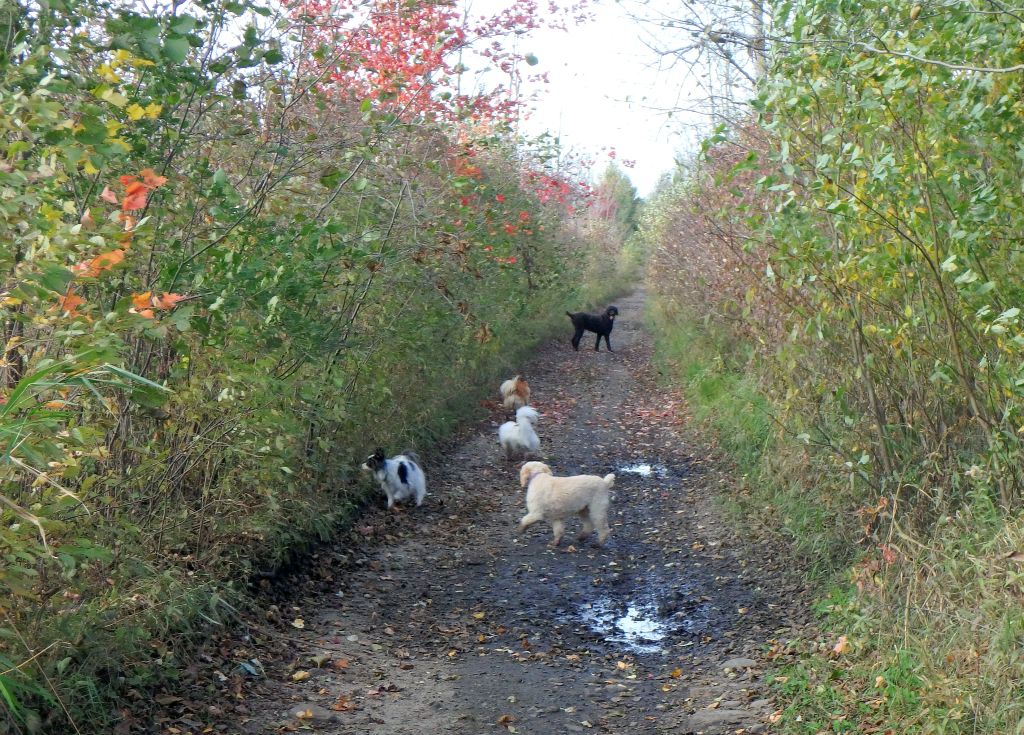
Jack often let the way, followed by Seamus, Daphne and Clover. Fergus often trots along at my side and that's what he was doing when I snapped this picture. We were almost back to the roadside where I'd parked, so I put the dogs on leashes and finished our hike. This trail is only 3 or 4 miles from home, a valuable asset:
Red Clover was in bloom along the trail. Certainly a common plant, it still surprised me to see flowers in bloom so late in the season:
Virgin's Bower Clematis seed heads made for a striking, autumn display:
When we returned to an access point to the main body of water, I encouraged the dogs to drink there instead of from puddles along the trail:
We were a happy group, making our way back along the trail:
The wind began to pick up as we arrived back at the bridge, and it was gusting with enough force that I wondered if a big storm was brewing. It turned out to be only wind, however, and merely added to the spirit of autumn in the air:
The dogs have seen so much water lately that they are enjoying it more than they used to:
And Beavers were clearly nearby. I wondered if the bush on the left had been Ironwood, but I never found out:
And then we came to a spot where the dogs could wade into shallow water, causing much excitement and merrymaking. I've seldom seen the dogs so happy. Perhaps it was a plot to get my car muddy, revenge for my not letting them run amok on the trail:
But when the fun was over, we kept walking:
This was an Insect Gall on a Goldenrod stem, a common sight along the edge of the trail:
Some places were so stunningly beautiful that I had to snap a photo. Notice the water and cattails in the center of the picture. These were marshes, and there was nowhere for a person to leave the trail:
Seamus and Fergus, my two "Poodly" hikers:
This Chicory flower caught me by surprise. Chicory quit blooming a long time ago. This was indeed a strange year, with warmer temperatures later into the season:
Jack often let the way, followed by Seamus, Daphne and Clover. Fergus often trots along at my side and that's what he was doing when I snapped this picture. We were almost back to the roadside where I'd parked, so I put the dogs on leashes and finished our hike. This trail is only 3 or 4 miles from home, a valuable asset:
Subscribe to:
Posts (Atom)