The dogs and I were walking the narrow strip of land along the St. Regis River at Santa Clara, NY (see also Parts 1 and 2, posted previously):
I recognized these Roughleaf Dogwood berries right away. This bush grows everywhere around the farm and its flowers are spectacular for a couple of weeks each year. The berries were plenty handsome also:
I'd planned to cut back up to the trail for our return trip but never saw an easy access - so we simply began retracing the route we'd taken along the river's edge. That was fine with the dogs, who loved wading out among the Bullhead Lilies:
It was a hot day and Daphne knew how to keep cool:
Another Cardinal Flower:
We finally got back to the trail and began our return to the parking lot:
But of course I had to stop for these Lowbush Blueberries and eat some:
Like much of the Adirondacks, the soil here is very sandy, sometimes almost all sand:
Many of the roads here are lined with millions of Black-eyed Susans, but on this trail there were only a few:
We were almost back to our car and I continued to let the dogs run and play as we had the entire place to ourselves. This was a short, easy hike, just right for a hot summer day:
Showing posts with label Black-Eyed Susan. Show all posts
Saturday, August 10, 2019
Friday, August 24, 2018
Wildflower Fence Walks
I took two walks one day along the fence line, once for enjoyment and once to repair the fence. I was amazed both times at the spectacular displays of wildflowers I saw. This wild collection for instance was Queen Anne's Lace, Red Clover, Black-Eyed Susan and Goldenrod:
Just a few steps farther and I saw Common Boneset (more on this later in this post), Purple Loosestrife and Goldenrod:
But what on earth were these tiny, daisy-like flowers? I took a number of photos to look them up back in the house:
I looked them up and decided that they were probably Tradescant's Aster, a new plant for me. I later found a picture of Prairie Fleabane and thought that it might be that also. Whatever it was, it was interesting:
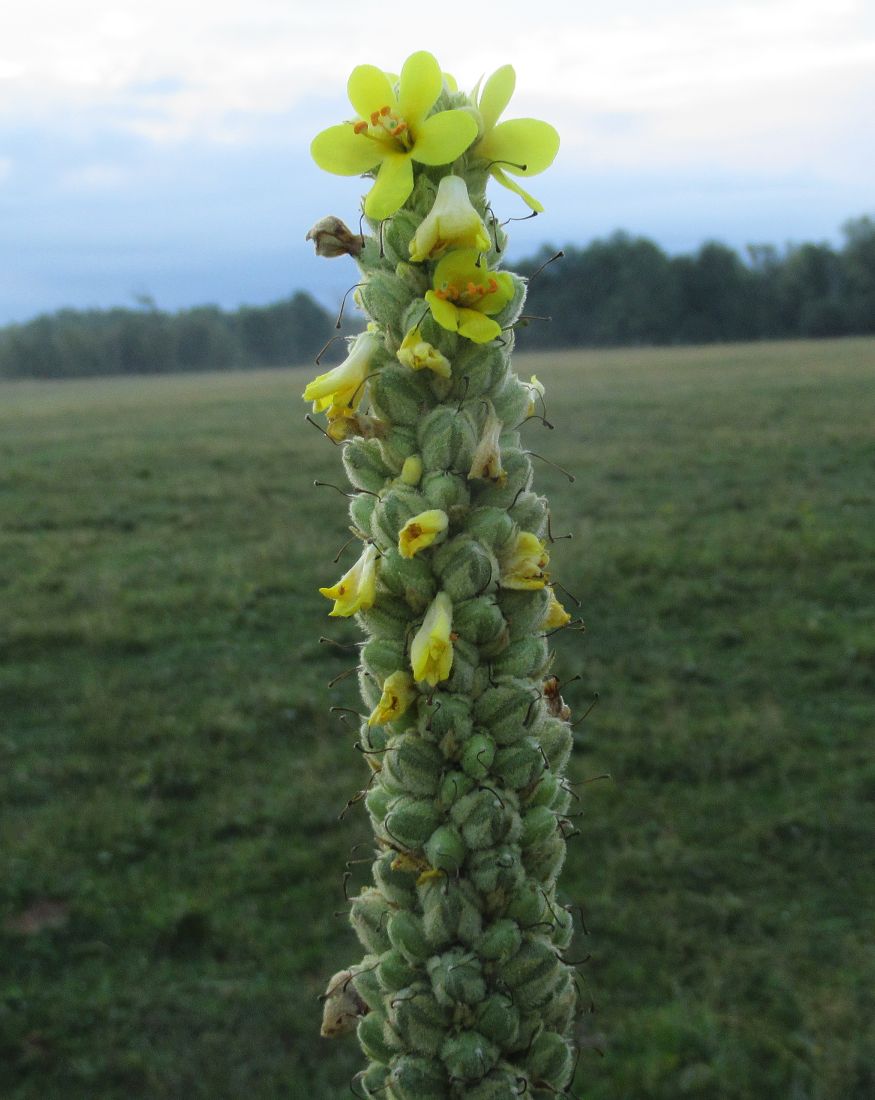
This single Common Mullein stood five feet high and right next to the fence wire (I'd turned off the electricity):
A close-up of Common Mullein's flowers:
This was a familiar old favorite which, for most of my life, I called Coffee Grounds. The real name is Curly (or Curled) Dock, but when we were kids, we'd strip the seeds from the stalk and pretend they were coffee grounds, which they did resemble:
I don't remember Common Boneset ever growing in my fields before, but there is a lot of it this year:
Boneset got its name because its leaves are joined at the stalk, prompting pioneers to think it could heal broken bones. Native Americans knew better and used it for fevers and as an antibiotic/anti-viral. Some people still use it today:
My photo of these minuscule flowers wasn't very good. They were exceedingly small and looked a lot like Lobelia flowers. I looked them up when I got back to the house and decided that they were indeed a form of Lobelia, named Indian Tobacco. They were mostly lavender color although they look white in this photo:
Queen Anne's Lace and St. Johnswort. The day honoring St. John's Day beheading is coming up and I must remember to test the sap to see if it is red:
Just a few steps farther and I saw Common Boneset (more on this later in this post), Purple Loosestrife and Goldenrod:
But what on earth were these tiny, daisy-like flowers? I took a number of photos to look them up back in the house:
I looked them up and decided that they were probably Tradescant's Aster, a new plant for me. I later found a picture of Prairie Fleabane and thought that it might be that also. Whatever it was, it was interesting:
This single Common Mullein stood five feet high and right next to the fence wire (I'd turned off the electricity):
A close-up of Common Mullein's flowers:
This was a familiar old favorite which, for most of my life, I called Coffee Grounds. The real name is Curly (or Curled) Dock, but when we were kids, we'd strip the seeds from the stalk and pretend they were coffee grounds, which they did resemble:
I don't remember Common Boneset ever growing in my fields before, but there is a lot of it this year:
Boneset got its name because its leaves are joined at the stalk, prompting pioneers to think it could heal broken bones. Native Americans knew better and used it for fevers and as an antibiotic/anti-viral. Some people still use it today:
My photo of these minuscule flowers wasn't very good. They were exceedingly small and looked a lot like Lobelia flowers. I looked them up when I got back to the house and decided that they were indeed a form of Lobelia, named Indian Tobacco. They were mostly lavender color although they look white in this photo:
Queen Anne's Lace and St. Johnswort. The day honoring St. John's Day beheading is coming up and I must remember to test the sap to see if it is red:
Tuesday, July 31, 2018
A Hot Summer, Full Of Life
The Rugosa Roses had few blossoms on them as July began drawing to a close, but the wildflower called Bouncing Bet burst into bloom beneath them to make up for it:
Our drought became so severe that the few Rugosa Rose buds we had shriveled and dried. This clump reminded me of the scene I imagined when I read of Miss Havisham's decades old wedding celebration, locked in time, from the book, "Great Expectations:"
The two baby pigeons forsook any semblance of a nest and just lived on the floor - but they grew at an astounding rate:
Both parents were excellent, rushing to feed them whenever they peeped:
Two more babies hatched, each in a separate nest with different parents, and lived through their first few days. That made me hopeful they'd grow to maturity, though what I'll do with more pigeons is a question I haven't yet answered:
The newly planted baby Day Lilies did well and continued to bloom in spite of the drought because I watered them every morning. The first to bloom was this variety, called "Chicago Arnie's Choice:"
The wildflowers are accustomed to droughts and other natural calamities, and they continued to bloom with abandon. The Black-Eyed Susans began to flower in mid-July:
And my property was filled with white and yellow butterflies. I had a hard time getting any photos because they seldom held still, and identification was also difficult because there were three common and nearly indistinguishable species for each color. These butterflies, I decided, were called Cabbage Whites:
It make take a second or two to notice the yellow butterfly in this photo. I decided that this species was Clouded Sulfur:
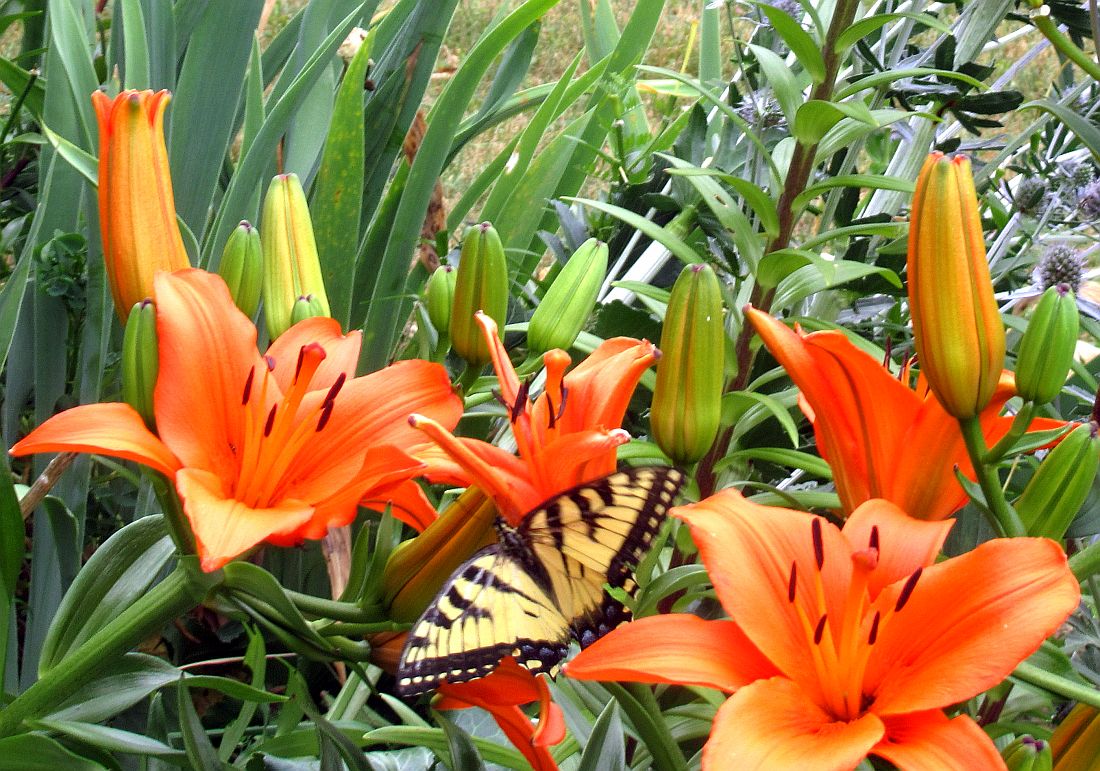
But the Canadian Swallowtails which loved my orange Asiatic Lilies were easy to identify and nearly impossible to miss:
Scenes such as these make summer, even a hot and dry one, a treasure to remember:
My sister visited and came to church with me on Sunday morning because I would be singing in a duet. This photo reminded me of photos of the two of us as children out in front of our childhood home, all ready for church on a Sunday morning. It also reminded me of photos of my parents as children, taken similarly on summer days with their siblings. Once children, now adults, and things haven't really changed that much except for the natural aging process:
Our drought became so severe that the few Rugosa Rose buds we had shriveled and dried. This clump reminded me of the scene I imagined when I read of Miss Havisham's decades old wedding celebration, locked in time, from the book, "Great Expectations:"
The two baby pigeons forsook any semblance of a nest and just lived on the floor - but they grew at an astounding rate:
Both parents were excellent, rushing to feed them whenever they peeped:
Two more babies hatched, each in a separate nest with different parents, and lived through their first few days. That made me hopeful they'd grow to maturity, though what I'll do with more pigeons is a question I haven't yet answered:
The newly planted baby Day Lilies did well and continued to bloom in spite of the drought because I watered them every morning. The first to bloom was this variety, called "Chicago Arnie's Choice:"
The wildflowers are accustomed to droughts and other natural calamities, and they continued to bloom with abandon. The Black-Eyed Susans began to flower in mid-July:
And my property was filled with white and yellow butterflies. I had a hard time getting any photos because they seldom held still, and identification was also difficult because there were three common and nearly indistinguishable species for each color. These butterflies, I decided, were called Cabbage Whites:
It make take a second or two to notice the yellow butterfly in this photo. I decided that this species was Clouded Sulfur:
But the Canadian Swallowtails which loved my orange Asiatic Lilies were easy to identify and nearly impossible to miss:
Scenes such as these make summer, even a hot and dry one, a treasure to remember:
My sister visited and came to church with me on Sunday morning because I would be singing in a duet. This photo reminded me of photos of the two of us as children out in front of our childhood home, all ready for church on a Sunday morning. It also reminded me of photos of my parents as children, taken similarly on summer days with their siblings. Once children, now adults, and things haven't really changed that much except for the natural aging process:
Sunday, August 27, 2017
West Parishville State Forest - Part 1
Another fine August day, another trip to a new (for me) local state forest with the dogs, this time to the West Parishville State Forest. I pulled about a hundred feet off the road and parked in the forest, and one of the first things I noticed was this brilliantly colored Bigtooth Aspen leaf. Yes, tree leaves are beginning to turn autumn colors already:
But it was a fine day in a beautiful location, so I let the dogs loose and they exploded with joy - so much so, in fact, that I had to yell at them to keep them from running too far ahead:
We veered off the trail early, in order to explore this stand of Scotch Pines growing in a carpet of moss. Daphne gave me her biggest smile:
Seamus looked almost skinny with his new haircut, and he seemed to feel extra energetic without all that fur he had been carrying:
Fergus, Jack and Daphne smelled something worrisome, for they stopped running and proceeded cautiously into a mossy clearing. Whatever they smelled was long gone, however:
There were yellow mushrooms growing in lots of places:
Seamus wasn't the only one with a new haircut. Just look at how spiffy Fergus looks:
The trail began as an all purpose trail, open to hikers, horses, skiers, snowmobiles, ATVs and cars. But this was pretty remote country and we saw no one all the time we were there:
Black-Eyed Susans bloomed wherever the sun got through the tree canopy to the ground:
And it was a happy excursion for all of us, though I'll admit I did have to yell at the dogs a lot at first:
Most of my wildflower photos were duds, but this one came out alright. I searched my field guide and decided it was Germander, a member of the mint family. The leaves didn't quite match, but then I saw a variety called littorale, which has narrower leaves - just like these plants:
The all purpose trail ended at private property, but a foot trail spurred off into the deep forest. Now this was more like it! I'll post Part 2 tomorrow:
But it was a fine day in a beautiful location, so I let the dogs loose and they exploded with joy - so much so, in fact, that I had to yell at them to keep them from running too far ahead:
We veered off the trail early, in order to explore this stand of Scotch Pines growing in a carpet of moss. Daphne gave me her biggest smile:
Seamus looked almost skinny with his new haircut, and he seemed to feel extra energetic without all that fur he had been carrying:
Fergus, Jack and Daphne smelled something worrisome, for they stopped running and proceeded cautiously into a mossy clearing. Whatever they smelled was long gone, however:
There were yellow mushrooms growing in lots of places:
Seamus wasn't the only one with a new haircut. Just look at how spiffy Fergus looks:
The trail began as an all purpose trail, open to hikers, horses, skiers, snowmobiles, ATVs and cars. But this was pretty remote country and we saw no one all the time we were there:
Black-Eyed Susans bloomed wherever the sun got through the tree canopy to the ground:
And it was a happy excursion for all of us, though I'll admit I did have to yell at the dogs a lot at first:
Most of my wildflower photos were duds, but this one came out alright. I searched my field guide and decided it was Germander, a member of the mint family. The leaves didn't quite match, but then I saw a variety called littorale, which has narrower leaves - just like these plants:
The all purpose trail ended at private property, but a foot trail spurred off into the deep forest. Now this was more like it! I'll post Part 2 tomorrow:
Monday, August 14, 2017
St. Regis River Access Plants - Part 1
I decided to take the dogs for a quick hike at the St. Regis River boat launch site in Santa Clara, NY. It's a short, easy hike and I can count on finding lots of spectacularly colored Cardinal Flowers at this time of year. To my surprise, there were so many wildflowers in bloom that I came home with a camera full of photos. So I've separated the dog pictures from the plant pictures. The beginning of the hike featured lots of Goldenrod:
And lots of Common Milkweed:
And, like most waste places, lots of Spotted Knapweed:
The sandy soil also supported Reindeer Lichen and Wild Strawberries. Those red spots you see behind the strawberry plants were not berries, but red leaves:
Tree Club Moss (Princess Pine). At least I think that's what kind it was:
There was lots of Meadowsweet growing everywhere at the dry, sandy beginning of the hike:
And Meadowsweet also grew along the riverbank, where the soil was probably richer and moister:
Black-Eyed Susans abounded but I somehow only got this one photo. It was next to a Scotch Pine:
Common St. Johnswort, like some of the other wildflowers, seems to be everywhere right now. It must be a good year for it:
The Chokecherry, Prunus virginiana, was producing fruit but I didn't taste it. I probably should have:
More Chokecherry. I'll post Part 2 tomorrow:
And lots of Common Milkweed:
And, like most waste places, lots of Spotted Knapweed:
The sandy soil also supported Reindeer Lichen and Wild Strawberries. Those red spots you see behind the strawberry plants were not berries, but red leaves:
Tree Club Moss (Princess Pine). At least I think that's what kind it was:
There was lots of Meadowsweet growing everywhere at the dry, sandy beginning of the hike:
And Meadowsweet also grew along the riverbank, where the soil was probably richer and moister:
Black-Eyed Susans abounded but I somehow only got this one photo. It was next to a Scotch Pine:
Common St. Johnswort, like some of the other wildflowers, seems to be everywhere right now. It must be a good year for it:
The Chokecherry, Prunus virginiana, was producing fruit but I didn't taste it. I probably should have:
More Chokecherry. I'll post Part 2 tomorrow:
Subscribe to:
Posts (Atom)