Showing posts with label general store. Show all posts

Wednesday, April 4, 2018

The Massena, New York Museum - Part 2

I was touring the Massena, NY Museum (see also Part 1, posted yesterday) and stopped at this old writing desk for a closer look:

 Victorian Era wicker wheelchair and crutches. I thought the uniforms were from World War I but wasn't sure, and I saw no signs to tell me:

There was kitchen furniture and furnishings from a variety of eras:

An old still, probably the only real one I've ever seen:

And this mysterious object. I'll bet you don't know what it is. It's a bottle capper from Massena Springs (see also next photo):
 

I knew nothing of Massena Springs, so I checked the town website and learned this:

During the 1800’s, Massena grew in prominence as a health retreat as people flocked to the area to enjoy the medicinal benefits of bathing in the sulfur mineral springs found along the Racquette River. Known to the Indians as Kanaswastakeras, meaning "the place where the mud smells bad," the Iroquois had been visiting the springs and using the waters for their "curative" powers for generations before settlers from New England and Europe came to this area. The Indians described the springs as a place where many moose, deer and their sick brothers would come to drink the healing waters.

The sulfur springs provided a booming economy for the place known as Massena Springs, N.Y. Many grand homes and hotels opened and grew to accommodate the many people who would come to "use The Massena Waters." For those who couldn't travel here, the curative waters were locally bottled and shipped far and wide:

I kept having the feeling that I was being watched, and this exhibit was the reason why. This woman tended an old fashioned general store, comprised of artifacts from former Massena merchants:


This Dayton scale (early 1900s) was once used in Tarpenian's Grocery Store. The store counter was once used in "Honest John" Serabian's store:


Lots of old grocery items, but it was calendar which caught my eye. It was from September, 1946,  before I was even born. I've reached the age when I see lots of things in museums which are younger than me, and it was a pleasure to see this calendar which was older than I:

An old cash register from Podgurski's store:

Uniform and switchboard from the Massena Police Station in the 1950s:

And a phone book from 1953-54 to authenticate it. Massena was called "The Aluminum City" because of the aluminum production plants which once ruled the city. Only Alcoa is left, and that has a much reduced workforce now. Massena was a boom town in the heyday of aluminum production and again during the construction of the St. Lawrence Seaway. I have been told that Massena's population is now only half of what it once was:

This was my last stop for the day, a collection of items saved by local residents and donated to the museum. I'll have to return when they other half of the museum opens:

Monday, November 13, 2017

Wagner Road In Moira, New York - Part 2

I was taking a driving tour of Wagner Road in the rural town of Moira, New York (see also Part 1, posted yesterday). This old barn was in good repair and appeared to be used for horses:

And speaking of horses, this herd were out in their pasture and I had to use the zoom lens to get a photo of them:

An old barn, out behind a more modern house:

Another horse, almost hidden behind a row of trees:

A large, one story barn, probably a cattle barn, which appeared to be unused, and sat behind a recently harvested corn field:

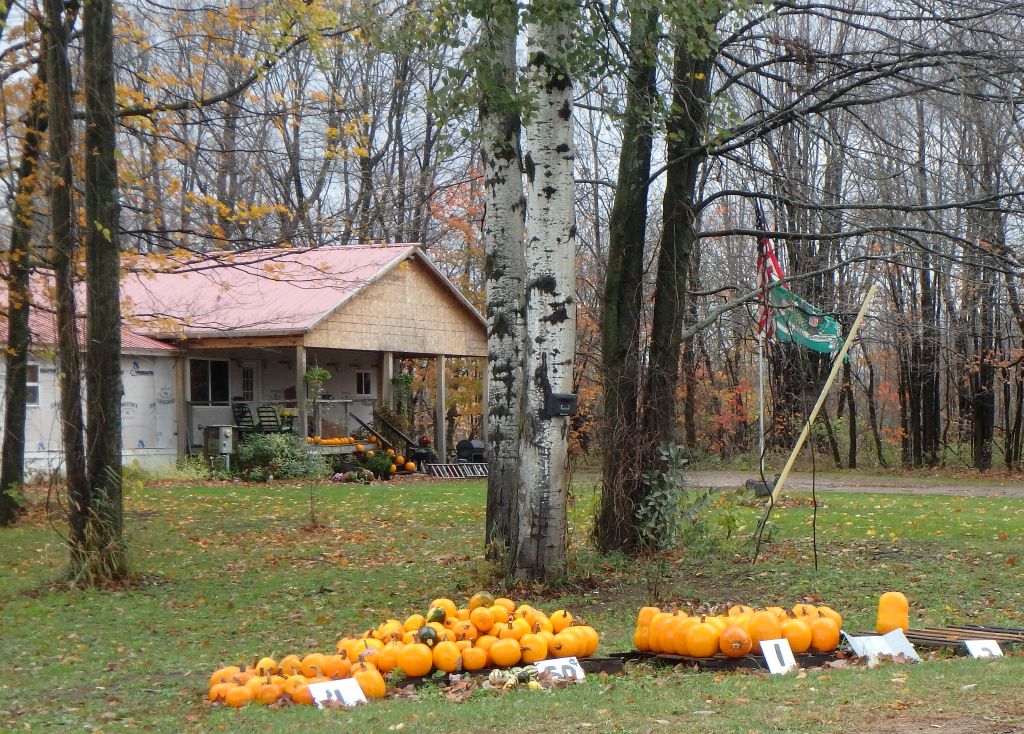
This house still had pumpkins for sale. There was only one $2 pumpkin left, but a good selection of  50¢ and $1 pumpkins for the local trade:

The same house harvested and sold maple syrup:

At the end of Wagner Road, I turned onto County Route 8 and photographed these two barns, one old and collapsing, the other newer and in good shape:

I continued on towards Malone on County Route 8 but stopped for a photo of this autumn corn field:

And one photo of this local resource, the Farm-to-Market Country Store:

Thursday, April 20, 2017

Massena N.Y. Town Museum - Part 3

I was touring the Massena Museum and took a closer look at the general store exhibit (photo at the end of Part 2, posted yesterday).This scale was from the early 1900s and came from a local store, Tarpinian's Grocery:

This old cash register came from Podgurski's Store:

The Massena Police Department's switchboard and a uniform, both from the 1950s:

Instrument case from a doctor's office:

From the Purity Bakery:

I was advancing in history as I toured the museum, and things were beginning to look familiar to me. Then again, I am pretty darn old:

This reminded me of Easter dresses, worn by little girls to church on Easter morning:

A perfectly rendered model of the old Massena High School, displayed in a wood and glass case. Of course they have a modern high school now:

I wondered about the year of the model in the above photo, but then noticed an accompanying photo of the students from 1925. I suppose they were from about the same time:

More artifacts which I remembered from the old museum location:

A scene from a one room school:

An old Hoosier cabinet school and more vintage clothes. But this was the end of my tour. I asked about the hearse and funeral home display which I remembered from the old museum and was told that most of those artifacts would be moved here when an addition to the new building was completed:

Wednesday, April 19, 2017

Massena N.Y. Town Museum - Part 2

I was touring the Massena Museum in its beautiful new building (see also Part 1, posted yesterday) and had begun where the oldest artifacts were displayed. Massena, New York was settled in 1792 by French lumberjacks and the town has a very long history, at least compared to the surrounding area, which some would say was frontier not too long ago:

This old diving helmet surprised me and looked, at first, out of place. But then I read the sign and understood that it was a U.S. Navy diving helmet, worn by a local man (James Bero) when searching for lost boat engines in the St. Lawrence River and cleaning underwater gear as part of his job for the ALCOA plant. Massena was an aluminum town and, to a lesser extent, still is:

One end of the room held old furniture and old clothing, including a military uniform (Civil War? I forgot to check). It had lots of photos, maps, tools and memorabilia from bygone days in Massena:

A woman's dress from long ago:

And a gas street lamp from the 1920s, which once brightened  Andrews Street in Massena:

And a lovely old desk. The display of old time, hand fashioned locks and latches just to the left of the desk was especially fascinating and, when I got home, I regretted not having gotten a closeup of it:

A Victorian Hunzinger/Eastlake style chair, dating back to 1870-1890:

Mother and daughter, out for a stroll. I don't know what era this was from, but it was looking to me like the 1920s or 1930s. Part of what fascinates me about such artifacts is that people kept them in such good condition for such a long time:

An old wheelchair:

I bet you don't know what this is. I don't suppose anyone does these days. It was a bottle capper from the Massena Springs Bottling Co:

Military uniform and a still - which caused me to wonder if they were displayed together for some reason, or just coincidentally. There was an antique sign on the still but I was unable to read the old handwriting:

A recreation of an old time general store.  The counter came from a local store, owned by "Honest John Serabian." But there was still more to see in the Massena Museum, and I'll post Part 3 tomorrow:

Thursday, September 17, 2015

Franklin County House of History - Part 2

I was touring the downstairs rooms of the Franklin County Museum in Malone, New York (see yesterday's post):

The downstairs parlors were elegant and impressive. This obviously was once the home of a wealthy family:

I moved to the foot of the stairs, where antique baby dolls rested in antique carriages:

I've noticed before that museums have lots of baby dolls and dresses, especially wedding dresses, because women cherished them and kept them all their lives, passing them on to their heirs. I always think of how much a doll was loved by someone - or by several people in a family:

I climbed the stairs and entered a room dedicated to weaving and looms:

School groups come here and get to weave a short section of fabric, which is added to the previous groups' sections and displayed in long scarves:

There were also candle making displays where the school children got to see candles being made and a corn broom making machine. There was also a one room school house display. But what really caught my eye was this county themed quilt, memorializing some of the rustic beauty of the surrounding town and countryside:

There was a room crammed full of antique farm implements:

I found these old farm tools fascinating and I'll bet that some of them would still be useful today:

I returned to the kitchen to end my tour but was told that there was one more room, containing a general store. I had not seen that the last time I visited, so it was totally new and fascinating to me:

The general store was full of antiques for display but also had souvenirs for sale:

This was a lively and elaborate display, perhaps my favorite part of the museum tour. But I'd seen everything at that point, so I thanked my guide and began making my way home to do the evening chores: