Showing posts with label bark house. Show all posts

Tuesday, July 21, 2015

Six Nations Indian Museum - Part 3

I completed my tour inside the Six Nations Indian Museum in Onchiota, New York, and stepped out onto the deck to begin an examination of the outdoor exhibits:

There was an impressive stone stele, or monument, proclaiming the six nations of the Iroquois Confederacy to be "America's oldest ally:"

There was a small building, covered with birch bark:

A bark hut:

And the framework for a bark house:

There was an outdoor area for campfires, stories and ceremonies:

And a bark lean-to with cooking fire. There was also an entire row of cooking fires, many types for many uses:

A sign explained the Haudenosaunee Iroquois Territory:

I left the museum but couldn't leave Onchiota without stopping at this amazingly kitschy roadside attraction:

And directly across the road was this former tourist business, now just a memory:

A close-up of the side of the above building, showing a road sign for Kushaqua Mud Pond Road. Every road in the area seemed to have Indian names:

Monday, July 20, 2015

Six Nations Indian Museum - Part 2

I continued my tour of the Six Nations Indian Museum, where an amazing collection of artifacts bedazzled me. They had items from all six nations of the Iroquois Federation (and more), all crowded in together. There was too much to absorb in one trip:

An eagle claw necklace, a beaded belt and the head of a cane:

A close-up of the beaded sash. The sign said that the sash tells, in pictographic symbols, the lessons of the great Seneca teacher and prophet, Kaniatario:

More of the Condolence Cane, whose antlered head was seen in a previous photo:

A beaded belt, part of a charge to a group of young cousins to keep the council fire clean and respectable, to sweep it with a seagull's wing:

Prehistoric stone celts. A celt was a stone tool, similar to an adze, hoe or axe:

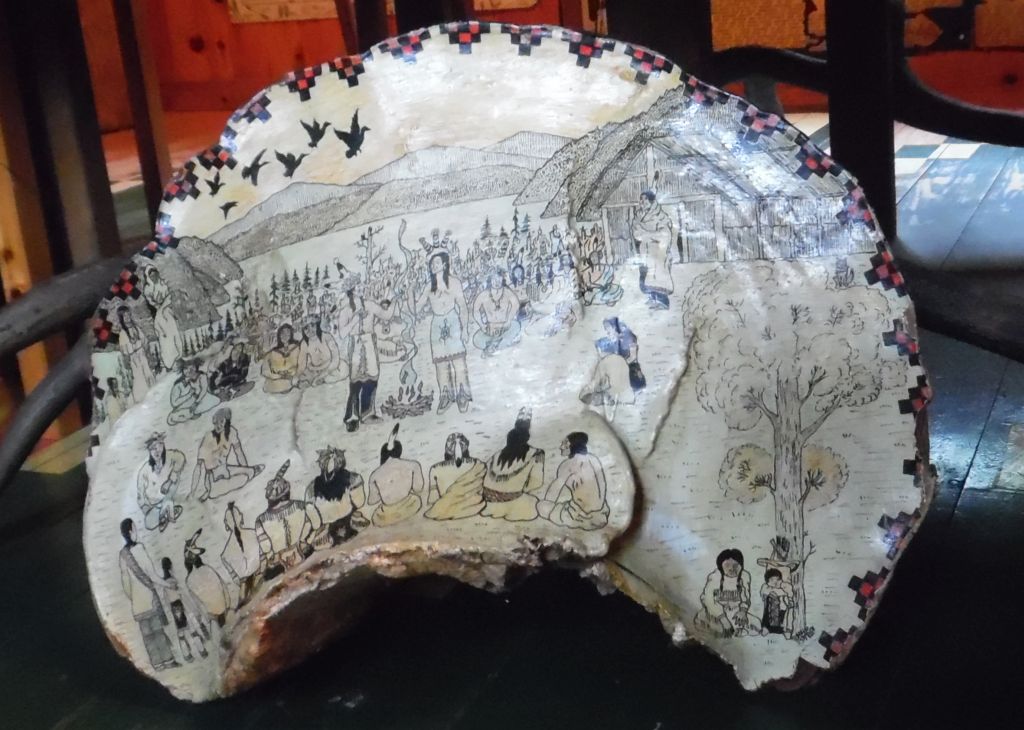
Amazing artwork on a very large shelf fungus:

A Cree necklace with a blue Mohawk neck ornament, showing a beaded bear head, announcing that the wearer was a member of the bear clan:

Another Mohawk neck piece, this one with a turtle clan symbol, representing the earth, and the tree of peace, representing the Iroquois Confederacy:

A highly ornamented, beaded, Oneida Tribal belt:

A reproduction of the original belt awarded to William Penn in celebration of a peace treaty:

A model of an Iroquois bark house. They were structured with cedar and other woods, and then covered with elm bark. 80 to 120 feet long, they were a home for an extended family, a matrilineal clan: