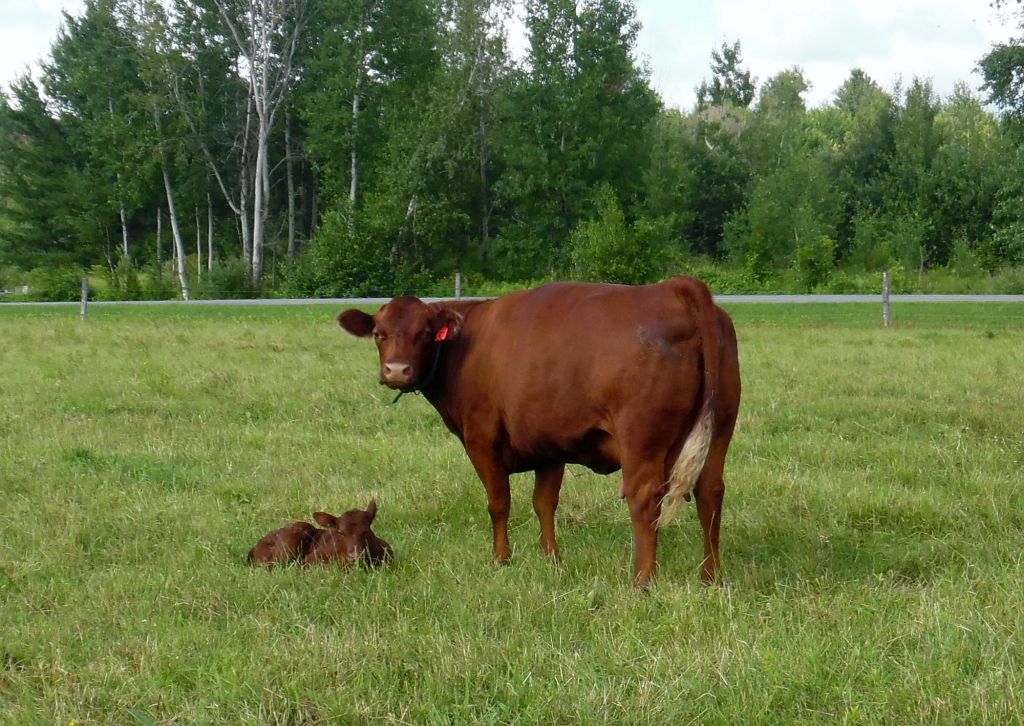
Amy's udder had been so huge for so long that I was truly worried. One day, I walked out on the back porch to let the dogs out and saw a calf emerge from Amy's behind. I grabbed my camera and went out to see what was happening:
The calf was huge, possibly even bigger than Rosella's white calf and I'd estimate its size to be equivalent to a purebred Red Poll at 2 to 3 weeks old:
Amy is a good mother, and set out to clean her new baby:
So Teddy, the bull, has now produced one white calf and one black calf. He was half Charolais and half Angus, so these colors were not surprising. I was a bit surprised to not have a red calf, but perhaps it's just a matter of random chance:
Amy stopped for a mouthful of hay before she continued working on her new baby:
And then she continued:
I couldn't get a very good look but, from what I saw, this was a heifer calf:
The new calf struggled valiantly to stand up, but kept tumbling back to the ground:
Rosella, a new mom herself, came over to see what all the commotion was about. Amy was not concerned by her presence. They are all part of a herd, kind of like sisters:
The little one finally managed to stand briefly, but then its front legs began sliding out to the side and it went down once again:
The new calf was active and healthy, but I never saw it nurse. Amy's udder grew ever more swollen and sore looking, with gigantic teats, low to the ground. After much thought, research and prayer, I decided not to risk the little calf starving to death. Amy's last calf died mysteriously at the age of 3.5 days and I kept thinking that maybe she couldn't nurse from that giant udder and slowly starved. I didn't want another dead calf. So two neighbors came over and we stole the little thing from the field and put it in a stall in the barn. That's where we learned that it was not a heifer, but a bull calf. I named him Elvis:
I bought powdered colostrum for the first feedings and powdered milk replacer for thereafter (boy, are they expensive!). Elvis wouldn't suckle at first, but once he swallowed the first time, he was hooked. I've been bottle feeding him twice a day ever since, with a bowl of grain and a bucket of water available, just in case he wants to try them. I have a nipple bucket for when his appetite grows bigger than the bottle can handle:
Showing posts with label new birth. Show all posts
Thursday, May 24, 2018
Monday, August 3, 2015
It's A Girl (Again!)
I was picking up rocks, from small to huge, from the barnyard and hauling them in the tractor bucket across the south field to a giant rock pile. I was on my way across the field when I looked to the right and saw, under a tree, this ugly, wet space alien:
It was a baby calf, Scarlett's second since she arrived here. The wet little thing was trying to stand, but not doing very well:
Rosella came over to investigate while Scarlett licked her baby and encouraged it to stand:
Finally on its feet, I looked carefully and decided it likely was a bull calf:
I finished the rock hauling and went back inside the house for a few hours. I came out later and found Scarlett and the new baby by the fence along the gravel road. I quickly turned off the electricity lest the wobbly baby fall against it:
Scarlett still had afterbirth hanging out of her back end, but she'd only given birth a few hours ago, so I didn't worry:
The baby stood up, wobbled, and tried to investigate its new world:
Ever the attentive mother, Scarlett followed it:
The baby turned its back toward me and lifted its tail. That's when I realized it was a heifer calf, not a bull calf. It's not as immediately obvious with a newborn calf as you might think. The best way seems to be to look at the bare patch under the tail. A newborn bull calf has one hole, which looks like a period. A heifer calf has two holes, which look like an inverted exclamation mark. Yep, she was a heifer:
I named her Pearl: and let her sleep, undisturbed, in the grass:
The other cattle came over to investigate every so often - especially Rosella (on the left). She is inquisitive and gets in the middle of everything. This is the exact spot in which Rosella was born (to the same mother) one year ago. This picture will illustrate how she's grown in twelve months:
I walked out into the far end of the south field the next morning. Scarlett and Pearl were doing well except that Scarlett still hadn't passed the afterbirth. I searched the internet and asked a neighboring dairy farmer what I should do. The answer was that I should leave her alone, even if it takes a week, only calling the vet if she becomes ill. So now my five cows have had five calves this year, four of them heifer calves and all sired by a famous bull. I hope to sell them when they are six months old:
It was a baby calf, Scarlett's second since she arrived here. The wet little thing was trying to stand, but not doing very well:
Rosella came over to investigate while Scarlett licked her baby and encouraged it to stand:
Finally on its feet, I looked carefully and decided it likely was a bull calf:
I finished the rock hauling and went back inside the house for a few hours. I came out later and found Scarlett and the new baby by the fence along the gravel road. I quickly turned off the electricity lest the wobbly baby fall against it:
Scarlett still had afterbirth hanging out of her back end, but she'd only given birth a few hours ago, so I didn't worry:
The baby stood up, wobbled, and tried to investigate its new world:
Ever the attentive mother, Scarlett followed it:
The baby turned its back toward me and lifted its tail. That's when I realized it was a heifer calf, not a bull calf. It's not as immediately obvious with a newborn calf as you might think. The best way seems to be to look at the bare patch under the tail. A newborn bull calf has one hole, which looks like a period. A heifer calf has two holes, which look like an inverted exclamation mark. Yep, she was a heifer:
I named her Pearl: and let her sleep, undisturbed, in the grass:
The other cattle came over to investigate every so often - especially Rosella (on the left). She is inquisitive and gets in the middle of everything. This is the exact spot in which Rosella was born (to the same mother) one year ago. This picture will illustrate how she's grown in twelve months:
I walked out into the far end of the south field the next morning. Scarlett and Pearl were doing well except that Scarlett still hadn't passed the afterbirth. I searched the internet and asked a neighboring dairy farmer what I should do. The answer was that I should leave her alone, even if it takes a week, only calling the vet if she becomes ill. So now my five cows have had five calves this year, four of them heifer calves and all sired by a famous bull. I hope to sell them when they are six months old:
Labels:
afterbirth,
calf,
cow,
new birth,
Red Poll cattle,
south field
Sunday, July 12, 2015
It's A Boy!
You may recall that wide-bodied Jasmine had everyone believing she was pregnant last summer, only to come into heat in late September. I had her artificially inseminated, but she seemed to be fooling me again this year. She grew even wider than usual and her udder began to fill with milk - but no baby. Finally, a full 21 days late, I discovered her out beneath a tree with a newly born calf:
She'd cleaned the little thing off and it was dry:
But it looked very to me to be a recent event. Jasmine's afterbirth was shimmering on the ground behind her and the little calf struggled to get to its feet, likely for the very first time. It was fun, watching it figure out how to stand:
It was not as obvious as one might suppose, but after looking, I pronounced the new calf a male and named him Merlin:
Merlin wobbled around his mom, but she didn't stand up. That worried me a little:
But finally she stood up and began eating the afterbirth. That, to most of us humans, is a yucky sight, but it's nature's way and would help her replenish vital nutrients and get her hormones kick-started:
I didn't want to upset her by getting too close to the little guy, so I used my zoom lens to get a better look:
The next morning brought lovely weather - cool, sunny and breezy. Jasmine and Merlin had by then joined the rest of the herd in the big pasture:
I watched, snapping photos, as Rosella approached tentatively:
Soon Rosella, ever the ham, was blocking my view and trying to get all the attention. She even got Jasmine to lick her. I had to walk around them to take pictures at a different angle:
Merlin is a purebred Red Poll bull calf from two distinguished lines, so I plan to treat him as a future breeding bull. I expect that someone will want him to add productivity and beauty to their herd:
She'd cleaned the little thing off and it was dry:
But it looked very to me to be a recent event. Jasmine's afterbirth was shimmering on the ground behind her and the little calf struggled to get to its feet, likely for the very first time. It was fun, watching it figure out how to stand:
It was not as obvious as one might suppose, but after looking, I pronounced the new calf a male and named him Merlin:
Merlin wobbled around his mom, but she didn't stand up. That worried me a little:
But finally she stood up and began eating the afterbirth. That, to most of us humans, is a yucky sight, but it's nature's way and would help her replenish vital nutrients and get her hormones kick-started:
I didn't want to upset her by getting too close to the little guy, so I used my zoom lens to get a better look:
The next morning brought lovely weather - cool, sunny and breezy. Jasmine and Merlin had by then joined the rest of the herd in the big pasture:
I watched, snapping photos, as Rosella approached tentatively:
Soon Rosella, ever the ham, was blocking my view and trying to get all the attention. She even got Jasmine to lick her. I had to walk around them to take pictures at a different angle:
Merlin is a purebred Red Poll bull calf from two distinguished lines, so I plan to treat him as a future breeding bull. I expect that someone will want him to add productivity and beauty to their herd:
Labels:
afterbirth,
calf,
new birth,
pasture,
Red Poll cattle
Wednesday, June 10, 2015
It's A Girl!
The chart I was given by the Artificial Insemination man used 280 days as the gestation period for cattle, and by that reckoning, Amy was a week late. Her udder was swollen and sore looking, and she seemed uncomfortable. A Google search informed me that up to 291 days is "normal" and for Red Polls, the average is 285 days. So I just waited and watched her as she looked miserable:
But nothing happened, so on day 287, I drove to Walmart to do some shopping. When I arrived home, I found Amy and her brand new heifer calf:
Amy's teats were swollen so big that I feared the baby couldn't drink from them. She was unable to do so when I took this photo. But even as I snapped the picture, I could see milky froth in the calf's mouth - so I knew she had already managed to find a way:
Amy, like Scarlett - but unlike Violet and Gracie, left her new baby hiding in the grass for most of the day in the manner of deer. That got me wondering if the calf's genetics or the mother's genetics determined which mothering style they'd use. Then it occurred to me that both Violet and Gracie calved when the grass was too short for hiding. Scarlett and Amy calved when the grass was tall enough. I still don't know the origins of mothering style:
It's very unusual to have three heifer calves in a row, and even more unusual to have four in a row (by adding Rosella into the count). That raised yet another question - Do bulls determine the gender of the offspring in the same manner as humans? I found no answer on the internet although I found other people wondering the same thing. If so, that should prove a powerful advertisement for bulls whose semen produces a preponderance of heifers:
I named the new girl Loretta but didn't see much of her for the first several days. Amy kept her hidden and, if I walked too close, they'd trot off across the field to keep away from me:
One day I walked right up to the two of them, sleeping in the grass. Neither one moved as I talked to them and brushed off the pesky flies. I think they were trying to avoid biting flies and considered me less of a threat than the insects:
Amy refused any grain for the first few days, as did Gracie and Violet before her. That got me speculating also. Was it just to avoid human contact right after calving or was it a survival behavior because their udders were painfully swollen? A retired dairyman neighbor stopped by to warm me that Amy's udder looked to be in danger of mastitis. I shared his concern but had watched the other cows swell up similarly and then gradually return to normal as their calves' appetites grew. Red Polls are beef cattle but have a great deal of dairy genetics. They produce much more milk than most beef breeds:
After a couple of days, Amy began bringing Loretta over to the barn and with her as the herd grazed:
And she began letting me get closer - but not too close:
All has gone well with Amy and Loretta, though I've been keeping a close eye on her swollen udder. I've been so very happy with the three calves produced by this bull that I plan to buy more of his semen for next year:
But nothing happened, so on day 287, I drove to Walmart to do some shopping. When I arrived home, I found Amy and her brand new heifer calf:
Amy's teats were swollen so big that I feared the baby couldn't drink from them. She was unable to do so when I took this photo. But even as I snapped the picture, I could see milky froth in the calf's mouth - so I knew she had already managed to find a way:
Amy, like Scarlett - but unlike Violet and Gracie, left her new baby hiding in the grass for most of the day in the manner of deer. That got me wondering if the calf's genetics or the mother's genetics determined which mothering style they'd use. Then it occurred to me that both Violet and Gracie calved when the grass was too short for hiding. Scarlett and Amy calved when the grass was tall enough. I still don't know the origins of mothering style:
It's very unusual to have three heifer calves in a row, and even more unusual to have four in a row (by adding Rosella into the count). That raised yet another question - Do bulls determine the gender of the offspring in the same manner as humans? I found no answer on the internet although I found other people wondering the same thing. If so, that should prove a powerful advertisement for bulls whose semen produces a preponderance of heifers:
I named the new girl Loretta but didn't see much of her for the first several days. Amy kept her hidden and, if I walked too close, they'd trot off across the field to keep away from me:
One day I walked right up to the two of them, sleeping in the grass. Neither one moved as I talked to them and brushed off the pesky flies. I think they were trying to avoid biting flies and considered me less of a threat than the insects:
Amy refused any grain for the first few days, as did Gracie and Violet before her. That got me speculating also. Was it just to avoid human contact right after calving or was it a survival behavior because their udders were painfully swollen? A retired dairyman neighbor stopped by to warm me that Amy's udder looked to be in danger of mastitis. I shared his concern but had watched the other cows swell up similarly and then gradually return to normal as their calves' appetites grew. Red Polls are beef cattle but have a great deal of dairy genetics. They produce much more milk than most beef breeds:
After a couple of days, Amy began bringing Loretta over to the barn and with her as the herd grazed:
And she began letting me get closer - but not too close:
All has gone well with Amy and Loretta, though I've been keeping a close eye on her swollen udder. I've been so very happy with the three calves produced by this bull that I plan to buy more of his semen for next year:
Labels:
artificial insemination,
beef cattle,
calves,
cows,
dairy cattle,
new birth,
Red Poll cattle
Sunday, May 24, 2015
Another Surprise Birth!
I imagine myself passing out cigars to the dogs, for another calf has been born - another surprise calf. The surprise was that it was earlier than I'd calculated, just like the last one. The problem in both cases was that I'd thought the cows were not pregnant and had them artificially inseminated again. I was wrong both times:
The cattle were in the north field and I'd planned to move them back to the south field before they gave birth. But the minute I walked out the back door that morning and saw Gracie, all by herself and searching for a place to feel comfortable, I knew I was too late:
I tried to get Gracie to come to the gate and across the road but she was already in labor. So I moved the other cows across the road so Gracie could be alone:
I came back out to check on her every so often all through the day. It was hot and she had no shade, so I worried about her. But there was nothing I could do to help. So I just kept coming out, checking on her and speaking gently and encouragingly - though I think she was beyond hearing me:
This went on so long that I prepared to call the large animal vet. But before I called, I went out one more time and saw the baby trying to emerge. I could see two hooves inside the sack but couldn't make out a nose. Nonetheless, Gracie stood back up and the baby slipped back inside. I returned to the house to wait some more:
The next time I came out to check, I discovered that I was too late. Gracie had just given birth to a rather large heifer calf and was cleaning her off:
The poor little thing hadn't even stood up yet but kept trying:
Here's a video of one of the new baby's first attempts to get on her feet:
Gracie's udder was so low to the ground that I feared the baby would have trouble finding a teat. I needn't have worried. She was nursing within minutes:
Gracie was a good mother, nuzzling her calf and protecting her:
I carried out some grain for mama and she ate about half of it. Later, I moved the other cattle back over so they could retain their herd connections and, I hoped, help lead Gracie and her calf back across the road to the south field in a couple of days:
.
The cattle were in the north field and I'd planned to move them back to the south field before they gave birth. But the minute I walked out the back door that morning and saw Gracie, all by herself and searching for a place to feel comfortable, I knew I was too late:
I tried to get Gracie to come to the gate and across the road but she was already in labor. So I moved the other cows across the road so Gracie could be alone:
I came back out to check on her every so often all through the day. It was hot and she had no shade, so I worried about her. But there was nothing I could do to help. So I just kept coming out, checking on her and speaking gently and encouragingly - though I think she was beyond hearing me:
This went on so long that I prepared to call the large animal vet. But before I called, I went out one more time and saw the baby trying to emerge. I could see two hooves inside the sack but couldn't make out a nose. Nonetheless, Gracie stood back up and the baby slipped back inside. I returned to the house to wait some more:
The next time I came out to check, I discovered that I was too late. Gracie had just given birth to a rather large heifer calf and was cleaning her off:
The poor little thing hadn't even stood up yet but kept trying:
Here's a video of one of the new baby's first attempts to get on her feet:
Gracie's udder was so low to the ground that I feared the baby would have trouble finding a teat. I needn't have worried. She was nursing within minutes:
Gracie was a good mother, nuzzling her calf and protecting her:
I carried out some grain for mama and she ate about half of it. Later, I moved the other cattle back over so they could retain their herd connections and, I hoped, help lead Gracie and her calf back across the road to the south field in a couple of days:
.
Labels:
calf,
cow,
heifers,
labor,
new birth,
North hay field,
Red Poll cattle,
udder
Subscribe to:
Posts (Atom)