Showing posts with label Mohawk Nation. Show all posts

Tuesday, February 2, 2016

Akwesasne Cultural Center Museum - Part 1

I left the farm and drove to Hogansburg, New York one cold morning. I wanted to take a second look at the Akwesasne (Mohawk) Museum at the Cultural Center. I knew I'd crossed into the reservation when I began seeing giant signs advertising cigarettes at cheap prices. I parked behind the cultural center and entered the museum:

There were signs which explained the exhibits, though I never saw any people. I learned here the story of the creation of the world. Sky woman fell from the sky and waterbirds helped her to land safely onto the turtle's back. A lacrosse player assisted the Sky woman as she fell. The native songs, dances and games help connect the people to the sky world:

Akwesasne Mohawk basket makers pound Black Ash logs to make splint, which is then soaked and the fibers scraped off by hand with a knife. Hand tools are used to split the splint into thinner layers and to cut it into the needed widths. Weaving is only one part of the process and is alternated with drying time, after which the weaves are packed tightly:

Baskets are also woven of Sweetgrass, though it wasn't always clear which were Black Ash and which were Sweetgrass. I suspected that many were a combination:

I remembered from a previous visit that this small basket was called, for obvious reasons, a strawberry basket:

Lacrosse is considered a medicine game which was first played in the Sky World and is now a bridge between earth and sky, a game to lift human spirits and to entertain the Creator:

Carving bone and antler is an ancient Iroquois tradition. This contemporary piece was done by Stan Hill, a Mohawk from the Six Nations territory near Toronto, Ontario:

Baby carriers, also called cradleboards, were individually decorated and came in a wide variety of designs:

The photo below this cradleboard shows how they were used:

Baskets were used for gathering and carrying food and medicine as the people gave thanks for their environment, the natural world:

This very large basket was striking:

There was a wide variety of baskets, expertly and artistically made. I took photos of only a few of them but there were many more to see at the museum. I'll post Part 2 tomorrow:

Tuesday, May 13, 2014

The Akwsasne Cultural Center Museum - Part 3

I was nearing the end of my tour of the Akwesasne Mohawk Museum and enjoying it very much. The displays were well lighted and had signs explaining things for novices like me. This was a turtle shell ceremonial rattle:

Beadwork was universally practiced by Native Americans, though originally the beads were laboriously crafted of stone, bone and shell. Europeans traded glass beads for furs, and they soon replaced the handmade beads. Nevertheless, beadwork continued to be important and still is today:

Items such as matchboxes, pincushions and this 1925 picture frame were produced for sale during the 1800s and early 1900s. Today, beadwork continues as an art form:

Beaded pendants:

Needle case made of cloth and glass beads:
 

Beads were combined with porcupine quills to produce beautiful objects such as these earrings:

This box demonstrated the fine art of quillwork. Porcupine quills and birch bark were combined in the traditional manner:

Moccasins with porcupine quillwork:

Historic pottery next to modern pottery:

This was my final photo of the day. I had learned a lot and enjoyed my tour of the museum. The people there were gracious and kind, but it was time for me to continue on my way. I had another destination in mind:

Monday, May 12, 2014

The Akwesasne Cultural Center Museum - Part 2

I continued my tour of the Akwesasne Mohawk Museum. These were a Snipe Clan pendant and a Bear Clan pendant. Clans are an important part of Akwesasne culture and identity:

Ironworker corn husk dolls. Mohawk people have a long tradition of ironwork and even today there are more than 300 Akwesasne Mohawks who are members of Ironworkers Local 440. Below that is a soapstone carving:

A beaded, hanging urn. Beaded items were made for sale in great numbers during the 1800s and early 1900s, though the use of glass beads began as far back as the 1600s and continues today:

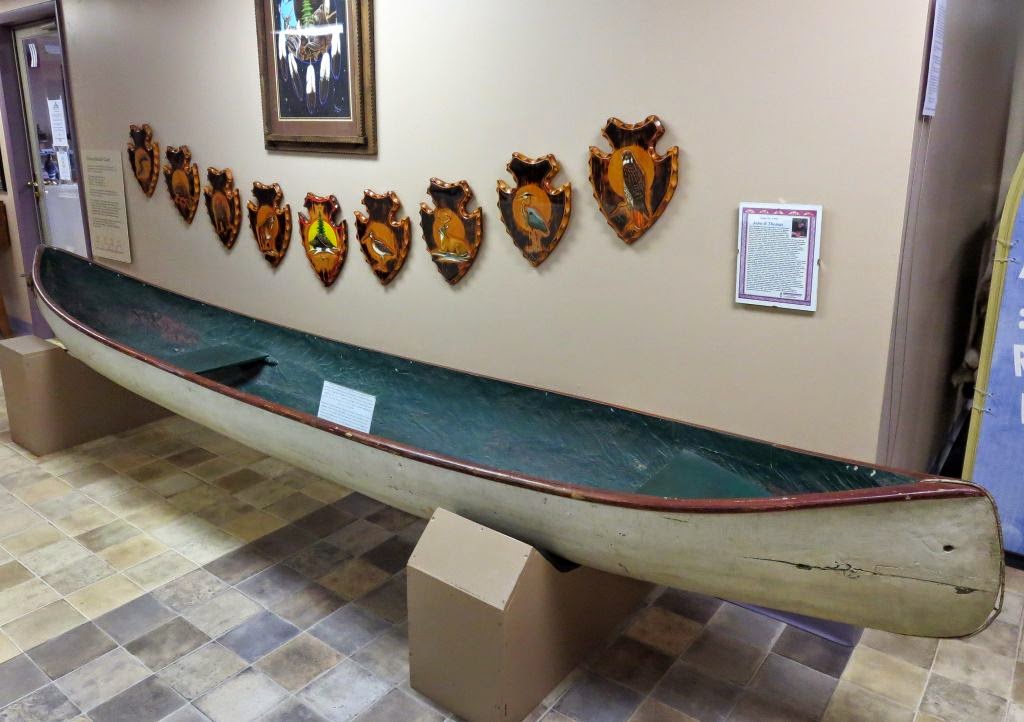
Dugout canoe, with emblems representing Mohawk Clans:

Lacrosse was more than a sport and was held sacred. A lacrosse player assisted the Sky Woman as she fell to earth in creation. She landed on the turtle's back and the sacred games helped connect the Mohawk to the sky world:

There were many lacrosse sticks on display:

More lacrosse sticks and baskets, including a strawberry basket:

Diorama of an early Akwesasne village:

The diorama from another angle:

Mohawk men wore traditional headdresses, feathered caps with a different insignia for each tribe. In times of war, the men shaved their heads except for the familiar crest down the center. Mohawk women sometimes wore special beaded tiaras. But there was still more to see at the museum, and I'll post Part 2 tomorrow:

Sunday, May 11, 2014

The Akwesasne Cultural Center Museum - Part 1

I'd planned a trip to the Akwesasne Cultural Center for a long time but kept putting it off. Finally, one cold and rainy day, I drove to Hogansburg, New York on the border of the St. Regis Mohawk Reservation to take a look:

Black ash splint and sweetgrass basketry is an important part of Akwesasne heritage, and the museum had lots of examples. That small red one was called a strawberry basket for obvious reasons:

The Akwesasne community is part of the Mohawk Nation and the Cultural Center had a library upstairs and a museum/gift shop downstairs. The exhibits held lots of extra bits of information like this one:

More basketry:

This Bald Eagle was carved from antler by a Mohawk master carver from the Six Nations territory in Ontario:

And there was an entire display case of Mohawk cradle boards, including a drawing which showed how they were used:

Another cradle board:

And yet another cradle board:

More baskets, with an explanation of the cultural importance of black ash and sweetgrass basketry plus the environmental conservation movement to protect these native materials, especially since the appearance of the invasive Emerald Ash Borer:

The partridge, or Ruffed Grouse. The word, "Akwesasne," means land where the partridge drums:

Mortars and pestles, probably for grinding corn. But there was lots more to see at the museum, so I'll post Part 2 tomorrow: