I was touring the Akwesasne Cultural Center Museum (see Part 1, posted yesterday) and stopped at these two stuffed partridge to read the sign. It explained that "Akwesasne" means "Land where the partridge drums:"
Everyday items for grinding corn, etc:
This soapstone carving represents the three sisters - corn, beans and squash. The face represents Mother Earth and the turtle shell represents Turtle Island, a term for this continent which originates with the creation story. The artist was Steve Kateroton McComber, a Mohawk:
A Bear Clan pendant, maker unknown, and a Snipe Clan Pendant, by Helen Laughing. Clans are one of the oldest aspects of Mohawk culture and are still important in Akwesasne as part of a person's identity:
This beaded hanging urn, maker unknown, was one of a wide variety of items made for sale in the late 1800s and early 1900s. The use of glass beads began in the 1600s and continues today:
A turtle shell rattle:
Three canoes, from top to bottom: Birchbark (collected in Akwesasne in 1925), Dugout (found on the banks of Earl Creek in 1972), and another, more sophisticated Dugout (purchased in Akwesasne in the late 1800s):
I've always loved dioramas, though they are devilishly hard to photograph. This was part of an extensive diorama which illustrated the layout of a typical village:
More exquisite baskets:
More beadwork and other objects of art:
I didn't notice the detail on this large basket until I got home and was editing photos. Then I noticed the tiny baskets all over its surface, but especially hanging from around the rim:
A horn rattle with bear carving (the bear is on the end of the handle):
Beadwork and Quillwork earrings:
Cloth and beadwork needle case:
Birchbark and porcupine quill box. And yet there was still more to see. I'll post Part 3 tomorrow:
Showing posts with label beadwork. Show all posts
Wednesday, February 3, 2016
Sunday, July 19, 2015
Six Nations Indian Museum - Part 1
It's open only in the summer, so I'd been waiting all winter to visit the Six Nations Indian Museum. One day I drove an hour southeast of home and, deep in the Adirondack forest, found the museum in the tiny settlement of Onchiota:
I walked up the ramp, paid $5.00 and began my tour:
Inside, a handsome young Mohawk introduced himself and offered to answer any questions I might have. I didn't know what to ask, but he did tell me a lot about the museum. He grew up in Onchiota, as this land and building used to be a summer camp, run by his grandfather. Now it's a museum and he lives on Cornwall Island, part of the Akwesasne Mohawk reserve up near Massena, except for the three months the museum is open:
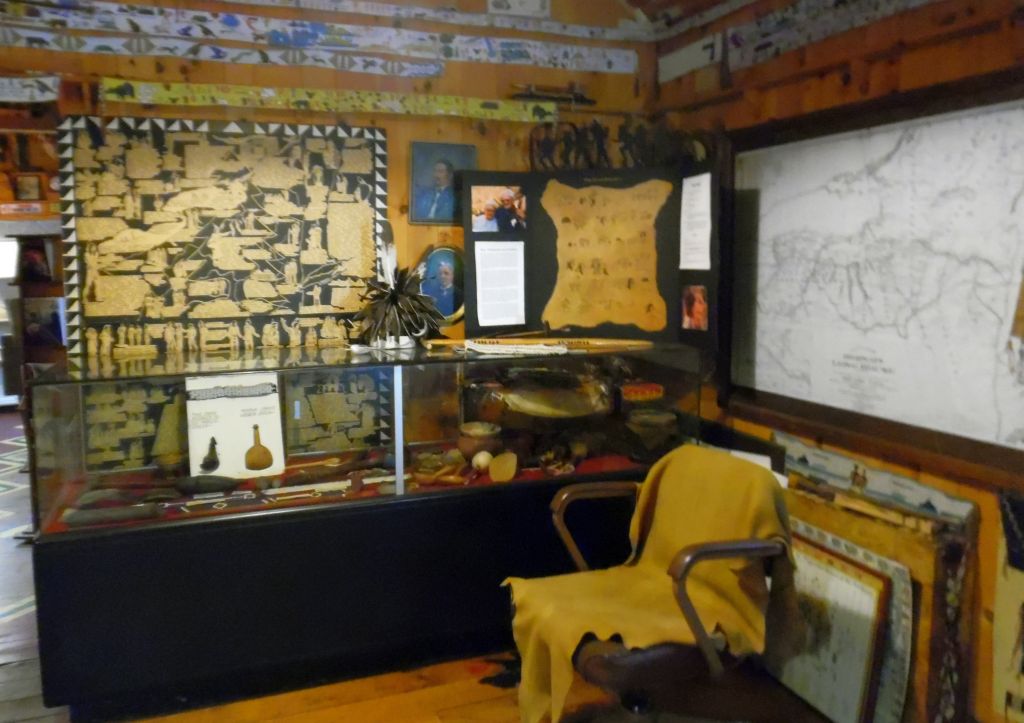
I began my tour, totally amazed by the wealth of materials and artifacts they had displayed. It was very difficult to photograph because of the lighting and reflections off the glass fronted cabinets. But that may be a blessing, as otherwise I might be posting pictures from this one place for a month or more. Even with all the photos which I had to discard, there are three posts:
Beaded moccasins - many of them, too many to show them all:
And speaking of beadwork, click on this to enlarge - and be amazed:
Many of the items which had dates were from the late 1800s, but most were not dated:
A cradle board and blanket, seemingly for use together:
Lacrosse sticks from many tribes:
Mohawk baskets. The nearby Akwesasne community is noted for its fine basketry:
A close-up of a Mohawk basket:
And many more, some fancier than others. But I'd just begun my tour of the Six Nations Indian Museum. I'll post Part 2 tomorrow:
Tuesday, May 13, 2014
The Akwsasne Cultural Center Museum - Part 3
I was nearing the end of my tour of the Akwesasne Mohawk Museum and enjoying it very much. The displays were well lighted and had signs explaining things for novices like me. This was a turtle shell ceremonial rattle:
Beadwork was universally practiced by Native Americans, though originally the beads were laboriously crafted of stone, bone and shell. Europeans traded glass beads for furs, and they soon replaced the handmade beads. Nevertheless, beadwork continued to be important and still is today:
Items such as matchboxes, pincushions and this 1925 picture frame were produced for sale during the 1800s and early 1900s. Today, beadwork continues as an art form:
Beaded pendants:
Needle case made of cloth and glass beads:
Beads were combined with porcupine quills to produce beautiful objects such as these earrings:
This box demonstrated the fine art of quillwork. Porcupine quills and birch bark were combined in the traditional manner:
Moccasins with porcupine quillwork:
Historic pottery next to modern pottery:
This was my final photo of the day. I had learned a lot and enjoyed my tour of the museum. The people there were gracious and kind, but it was time for me to continue on my way. I had another destination in mind:
Monday, May 12, 2014
The Akwesasne Cultural Center Museum - Part 2
I continued my tour of the Akwesasne Mohawk Museum. These were a Snipe Clan pendant and a Bear Clan pendant. Clans are an important part of Akwesasne culture and identity:
Ironworker corn husk dolls. Mohawk people have a long tradition of ironwork and even today there are more than 300 Akwesasne Mohawks who are members of Ironworkers Local 440. Below that is a soapstone carving:
A beaded, hanging urn. Beaded items were made for sale in great numbers during the 1800s and early 1900s, though the use of glass beads began as far back as the 1600s and continues today:
Dugout canoe, with emblems representing Mohawk Clans:
Lacrosse was more than a sport and was held sacred. A lacrosse player assisted the Sky Woman as she fell to earth in creation. She landed on the turtle's back and the sacred games helped connect the Mohawk to the sky world:
There were many lacrosse sticks on display:
More lacrosse sticks and baskets, including a strawberry basket:
Diorama of an early Akwesasne village:
The diorama from another angle:
Mohawk men wore traditional headdresses, feathered caps with a different insignia for each tribe. In times of war, the men shaved their heads except for the familiar crest down the center. Mohawk women sometimes wore special beaded tiaras. But there was still more to see at the museum, and I'll post Part 2 tomorrow:
Subscribe to:
Posts (Atom)